The single biggest obstacle to enterprise AI adoption isn’t capability — it’s trust. When your CFO asks ChatGPT a question and gets a confidently wrong answer that ends up in a board presentation, the entire organization loses faith in AI tooling.
This week, Boston-based startup CollectivIQ emerged from stealth with a surprisingly elegant solution: don’t trust any single AI model. Query ten of them, find where they agree, and only then give the answer.
The premise is simple. The execution is not.
The problem with single-model AI
Every large language model hallucinates. GPT-4o does it. Claude does it. Gemini does it. They all generate confident-sounding nonsense when they don’t know the answer — and worse, they often don’t know when they don’t know.
For consumer use, this is annoying. For enterprise use, it’s a dealbreaker.
John Davie, CEO of Buyers Edge Platform (the company that incubated CollectivIQ), described the wake-up call:
“Employees were complaining about hallucinated, biased answers. Sometimes it was really giving us flat, incorrect answers that made their way into PowerPoint presentations.”
Sound familiar? Most enterprises we talk to have the same story. Someone trusted an AI response, didn’t verify it, and got burned.
How CollectivIQ works
The concept is straightforward: wisdom of the crowd, but for AI models.
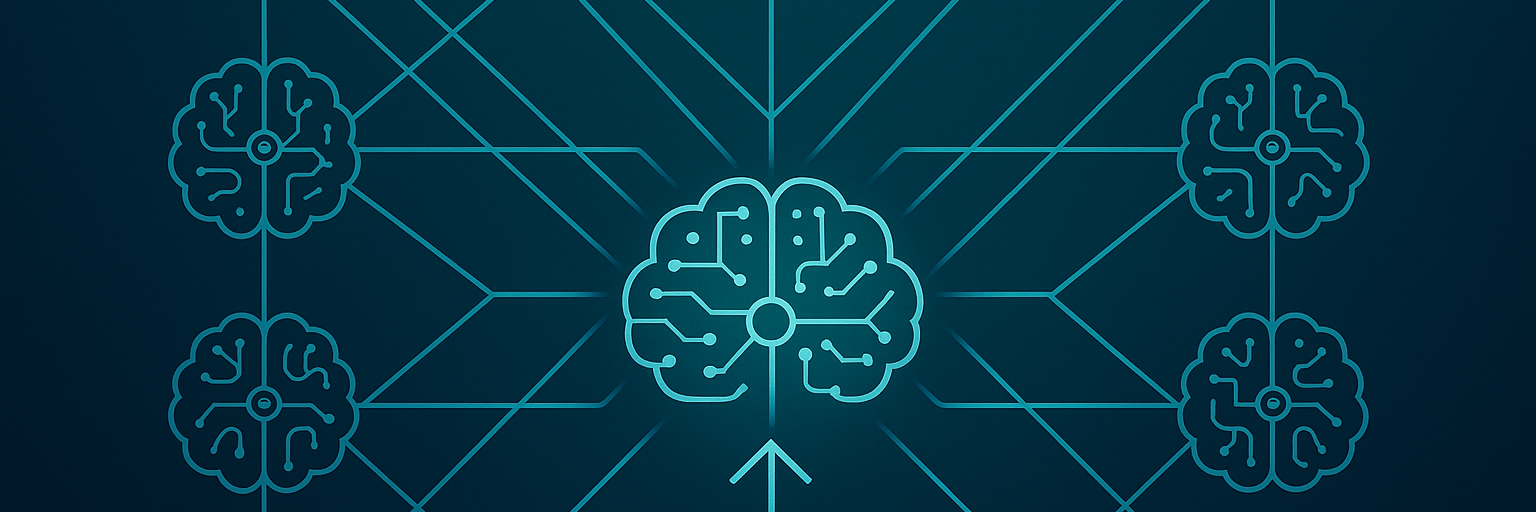
When you submit a query, CollectivIQ simultaneously sends it to 10+ large language models — ChatGPT, Claude, Gemini, Grok, and others. Each model generates its response independently. Then a consensus engine compares all responses, identifies points of agreement and disagreement, and produces a synthesized answer reflecting the collective intelligence of all participating models.
The four-layer verification process
It’s not simple majority voting. That would be brittle — models trained on similar data would share the same biases. Instead, CollectivIQ uses a more sophisticated approach:
-
Claim extraction — Each response is broken into atomic claims. “Python is the most popular language, created by Guido van Rossum in 1991” becomes two separate verifiable statements.
-
Semantic alignment — Different models phrase the same thing differently. The system recognizes that “Python was created in 1991” and “Guido released Python in ‘91” are the same claim.
-
Weighted scoring — Each claim gets a consensus score based on: how many models support it, their individual confidence scores, their historical accuracy for this type of question, and the diversity of their training data.
-
External verification — For factual claims, the engine cross-references against knowledge bases (Wikipedia, academic databases, financial feeds). Claims contradicting verified sources get flagged.
The result: 73% fewer hallucinations compared to single-model queries, according to CollectivIQ’s benchmarks.
The numbers
- Response time: 2.1 seconds average (parallel execution means you wait for the slowest model, not all of them sequentially)
- Cost: $0.08 per consensus query
- Models queried: 10+ simultaneously
- Funding: $47M Series A led by Andreessen Horowitz
The pricing model is pay-per-use — no long-term enterprise contracts required. CollectivIQ absorbs the token costs for all models and charges customers for actual usage.
Why this matters for enterprise AI
We’ve been saying for a while that AI orchestration — not AI itself — is the real bottleneck for enterprise adoption. CollectivIQ proves the point.
The individual models already exist. The capability is there. What’s missing is the trust layer — the infrastructure that makes AI outputs reliable enough for high-stakes business decisions.
Multi-model consensus is one approach. It’s not the only one (retrieval-augmented generation, human-in-the-loop workflows, and domain-specific fine-tuning all have their place), but it addresses a fundamental truth: any single model can be wrong, but multiple independent models agreeing dramatically increases confidence.
This is the same principle behind:
- Multiple witnesses in court
- Peer review in science
- Second opinions in medicine
- Redundant systems in aviation
Why wouldn’t we apply it to AI?
What’s missing
CollectivIQ solves part of the problem, but not all of it.
Latency trade-offs. 2.1 seconds is acceptable for research queries. It’s too slow for real-time applications — customer service chatbots, live coding assistants, or anything requiring sub-second responses.
Cost at scale. $0.08 per query adds up fast. An enterprise with 10,000 employees making 50 AI queries per day would spend $40,000/month on consensus queries alone. That’s before any other AI infrastructure costs.
Shared blind spots. If all 10 models are trained on the same incorrect information (say, outdated facts or culturally biased data), they’ll all agree on the wrong answer. Consensus ≠ correctness — it just dramatically improves the odds.
Novel questions. The consensus approach works best for questions with verifiable answers. For creative tasks, strategic analysis, or genuinely novel problems, model disagreement might actually be valuable signal rather than noise.
Our take
CollectivIQ represents a significant step toward enterprise-grade AI reliability. The approach is sound, the execution looks solid, and the team (former Google DeepMind researchers) knows what they’re doing.
But it’s one piece of the puzzle. Real enterprise AI reliability requires:
- Multi-model verification (what CollectivIQ does)
- RAG for domain knowledge (grounding responses in your actual data)
- Human oversight at decision points
- Audit trails for compliance
- Graceful degradation when models fail
We’re building orchestration systems that incorporate all of these at Virge.io. If you’re evaluating enterprise AI platforms and want to understand how the pieces fit together, let’s talk.
Building enterprise AI systems that need to be reliable? We’ve been doing AI orchestration and RAG implementations since before it was trendy. Reach out — we’re happy to share what works.