The conversation around RAG has fundamentally shifted. A year ago, enterprises asked “should we use retrieval-augmented generation?” In 2026, the question is “which RAG architecture fits our compliance model, cost tolerance, and scale requirements?”
RAG is no longer a feature. It’s infrastructure.
Why RAG became strategic infrastructure
Three structural shifts elevated retrieval from a hallucination-reduction technique to enterprise-critical architecture:
1. Enterprise knowledge exceeds model context
Even with million-token context windows, enterprise data ecosystems span billions of tokens across data lakes, SaaS systems, document repositories, and structured databases. Stuffing raw data into prompts is computationally wasteful and governance-risky. Strategic retrieval ensures only relevant, permission-compliant information enters generation.
2. Governance is non-negotiable
Enterprise AI must enforce role-based access, data lineage, audit trails, and explainability. RAG acts as a policy enforcement layer — filtering what the model sees before generation occurs. In regulated industries, retrieval design is compliance design.
3. Cost and latency hit the P&L
Uncontrolled prompt expansion creates unpredictable inference costs. A single complex query that retrieves too much context can cost 10x what it should. Modern RAG architectures introduce cost discipline by optimizing retrieval depth based on query complexity.
The RAG architecture landscape in 2026
Gone are the days of “just do vector search.” Enterprise RAG now splits into specialized patterns, each optimized for different workloads.
Naive RAG: the starting point
The simplest implementation: embed documents, store vectors, retrieve top-k similar chunks, pass to LLM. Still works for straightforward FAQ systems and internal knowledge bases where queries are predictable.
Best for: Simple Q&A, customer support deflection, documentation search Limitation: Fails on multi-hop reasoning, complex queries, or when lexical matching matters
Hybrid RAG: the production baseline
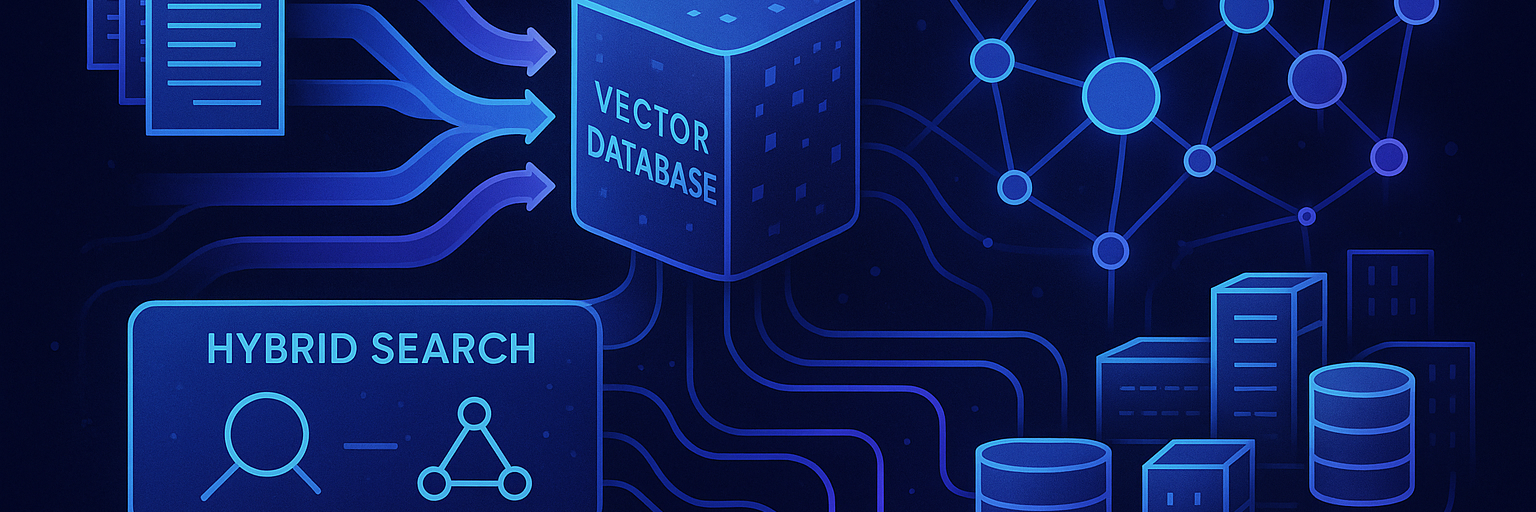
Combines vector similarity (semantic meaning) with keyword matching (exact terms). This is where most production systems land in 2026.
Why? Because embeddings alone miss obvious lexical matches. Ask about “GDPR Article 17” and pure vector search might return content about “data deletion rights” without the exact article reference. Hybrid search catches both.
Best for: Enterprise search, compliance documentation, technical corpora Our implementation: We built hybrid search for SURF Orchestrator-Core using PostgreSQL-native components — pgvector for semantic search, pg_trgm for fuzzy text matching, and tsquery for full-text search. No external vector database required.
Graph RAG: relationship-aware retrieval
When your data has complex relationships — organizational hierarchies, legal entity structures, supply chains — flat document chunks lose critical context. Graph RAG uses knowledge graphs to preserve and query these relationships.
Best for: Legal research, R&D knowledge bases, financial entity analysis Trade-off: Higher implementation complexity, requires graph construction and maintenance
Agentic RAG: autonomous exploration
The frontier. Agentic RAG systems don’t just retrieve — they reason about what to retrieve. An AI agent decides which data sources to query, evaluates results, determines if more context is needed, and iterates until the answer is sufficient.
AWS recently published work on Agentic GraphRAG for capital markets: agents automatically overlay structured relationship data with regulatory filings and news, determining query strategy on the fly.
Best for: Complex investigations, multi-system intelligence, research workflows Trade-off: Higher latency, less predictable costs, requires robust guardrails
Adaptive RAG: cost-optimized routing
Not every query needs the same retrieval depth. Adaptive RAG routes queries dynamically — simple questions get fast, shallow retrieval; complex queries trigger deeper, more expensive pipelines.
Best for: High-volume systems with mixed query complexity Trade-off: Requires query classification layer and careful routing logic
Self-RAG: built-in verification
Self-RAG systems include a reflection step — the model evaluates its own retrieval and generation quality, flagging low-confidence answers or requesting additional context. Critical for regulated domains where “I don’t know” is better than a wrong answer.
Best for: Healthcare, legal, financial advisory — anywhere wrong answers carry liability Trade-off: Higher latency, emerging maturity
The hybrid search sweet spot
If there’s one trend dominating production RAG in 2026, it’s hybrid search. The pattern keeps winning because it addresses a fundamental limitation of pure vector retrieval.
Vector embeddings capture semantic similarity — “automobile” and “car” are close together. But they can miss exact matches that matter: part numbers, legal citations, API endpoints, medical codes. Hybrid search combines:
- Semantic search (vector similarity) for meaning
- Lexical search (BM25, keyword matching) for precision
- Fuzzy matching for typo tolerance
The implementation doesn’t require exotic infrastructure. PostgreSQL with pgvector handles vector search, pg_trgm handles fuzzy matching, and native full-text search handles keyword queries. One database, multiple retrieval strategies, combined ranking.
We’ve deployed this pattern for eCommerce (product search that understands both “comfortable running shoes” and “Nike Pegasus 41”), legal tech (semantic understanding plus exact statute references), and enterprise knowledge bases (concept search plus document IDs).
Choosing the right architecture
The decision framework comes down to five questions:
| Question | If Yes → Consider |
|---|---|
| Are queries simple, single-fact lookups? | Naive RAG |
| Do you need both semantic and exact matching? | Hybrid RAG |
| Does your data have complex relationships? | Graph RAG |
| Do queries require multi-step reasoning across systems? | Agentic RAG |
| Is cost-per-query a hard constraint? | Adaptive RAG |
| Are wrong answers legally/financially risky? | Self-RAG |
Most enterprises end up with Hybrid RAG as the baseline, adding Graph or Agentic patterns for specific high-value use cases.
What we’re seeing in practice
At Virge.io, we’ve implemented RAG systems across eCommerce, legal tech, and enterprise knowledge management. The patterns that work:
Start hybrid, not naive. The incremental complexity of adding keyword search to vector retrieval is minimal. The accuracy improvement is significant. Don’t skip it.
PostgreSQL is enough. You don’t need Pinecone, Weaviate, or Qdrant for most enterprise RAG. pgvector plus native PostgreSQL text search handles 90% of use cases with simpler operations and lower cost.
Chunk strategy matters more than embedding model. We’ve seen bigger accuracy gains from better document chunking (respecting section boundaries, maintaining context) than from upgrading embedding models.
Retrieval evaluation is hard but essential. Most teams don’t measure retrieval quality separately from generation quality. When answers are wrong, is it because retrieval failed or generation failed? You need to know.
Agentic RAG needs guardrails. Autonomous retrieval agents are powerful but unpredictable. Without cost limits, latency bounds, and scope constraints, they can spiral into expensive, slow query chains.
The bottom line
RAG in 2026 isn’t a technique — it’s a strategic layer that determines AI reliability, compliance posture, and operational cost. The architecture you choose shapes what your AI systems can do and how much they cost to run.
Hybrid RAG is the production baseline. Graph and Agentic patterns unlock complex use cases. The key is matching architecture to workload, not reaching for the most sophisticated pattern by default.
If you’re evaluating RAG architectures for enterprise deployment, we’ve done this across multiple industries. Let’s talk about what fits your use case.
Building enterprise RAG systems? We’ve implemented hybrid search, GraphRAG, and agentic patterns in production. Reach out — we’re happy to share what actually works.